The work
Benjamin does not teach to a multiple choice test. He teaches change management, Excel and purchasing negotiation to license, master and engineering cohorts across more than 46 schools, and he assesses them on business cases. That means reading a document end to end and judging the reasoning inside it: does the introduction set up the problem, does the context hold, does the conclusion follow from the analysis.
So every assessment produces a written argument, not a number. He documents why a mark was given, section by section, partly because that is how his students learn and partly because a documented rationale is what protects him if a university or a student disputes a grade.
His view is that Generation Z students need the end to end reasoning, not the verdict. A quiz score teaches nobody anything. That belief is what makes the feedback loop, rather than the grading itself, the expensive part of his job.
The problem
Nobody has to convince Benjamin that asynchronous correction is worth the effort. He has recorded more than 5,000 hours of it on Excel alone, because a spreadsheet correction only makes sense if you watch the formula being built. The question was never whether to give detailed feedback. It was what to give it in.
Detailed feedback on a document is easy to write and painfully hard to deliver. Benjamin had been using Quick Reviewer until it was retired, which left him assembling the loop out of whatever was at hand: Word for comments, a PDF editor for marking up submissions, a drawing tool for anything visual.
Every one of those produces a different artefact in a different place. None of them let a student reply where the comment lives. And the tools that did produce a shareable link had their own failure mode: he ran into the same thing on a side project, where links to a screen recording tool simply went unopened by the developers they were sent to.
What he does with BugSmash
Benjamin uploads the student work himself rather than asking students to submit into the tool, and organises it by school and by program, so license, master and engineering cohorts stay separate. One folder structure covers the whole September to December assessment season.
Access is decided per review rather than per account, which is what lets that structure hold. A document can be public, private, or password protected, so a cohort reaches its own work and nothing else, and a piece of work that should not be circulating simply cannot be.
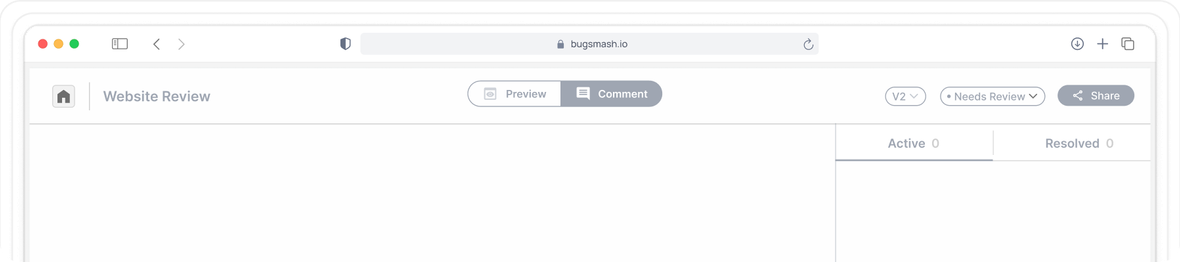
From there the loop is short:
It is so easy to switch. Comments and replies expected from anybody, without even signing up or having an account. And the thread sits inside my own website, which keeps the students in a safe location they already know.
Three kinds of document, one place to comment
Student work is only part of it. Benjamin runs two property sites of his own on the northern French coast: je-loue-a-berck.com , where he rents out a holiday flat in Berck-sur-Mer, and jevendsaberckplage.fr , where he is selling another. Both are built on plugins, and plugins break.
When one does, he ends up on the other side of the problem he sets for his students. He needs a plugin author who has never seen his site, and who is often working in a second language, to understand exactly what is wrong and where. In his words, explaining to the plugin editors where he could not succeed. So he points at it in BugSmash and sends the link. Same shape as a marked up business case: point at the specific thing, be understood, do not schedule a meeting to explain it.
Then there is the work that resembles neither. In July he had an NDA to go through for a confidential project. He commented on the PDF in BugSmash, the same way he marks up a student's business case, and sent his remarks back attached to the clauses they referred to. That a contract under NDA went through the same tool as a first year business case is the point. Everything moving between him and whoever opens the link is encrypted in transit, and a link can be kept private or opened up depending on what the document is.
A marked up business case, a broken plugin on a holiday rental site, an NDA. Three unrelated kinds of document, three completely different people on the other end, one place to put remarks on all of them.
The result
Benjamin puts the saving at roughly three hours a week across his assessment season, which runs September through December. Over the four months that is close to 48 hours , more than a full working week returned to teaching and coaching rather than to the assembly and distribution of feedback. It is the right trade: none of that time came out of thinking about the student work itself.
The website work saves time in a different currency. There the cost was never hours at the desk, it was rounds. Describing a broken plugin in writing to someone who has never seen your site takes a message, a screenshot, a reply asking which page, another screenshot. Each round is a day gone to a support queue and a time zone, and none of it is work, it is just the two of you trying to agree on what you are looking at. Pointing at the thing and sending the link removes the rounds rather than shortening them. That is what he means by dealing with the editor very quickly.
The larger change across both is that the loop is now a single artefact. One link, one place, one thread. Ease of use and speed of sharing are why it stuck, and it replaced three tools that each did a slice of the job. Screen recording still has its place for Excel, where the correction has to be watched rather than read.
This app is a GEM. It is a must and it would be a mistake to miss this app from your toolbox, as a teacher or as a solopreneur.
Case study prepared with Benjamin Pierre. Published with his approval.